

I have been hesitant to weigh in on the war in Iran for one simply reason; having read a lot of history over the course of the past decade, I have learned that we have to let at least some of the dust settle before opining on any subject of great import. And when we look at JFK’s assassination for example, even six decades are occasionally not enough time for all of the dust to settle.
But in this case, while it is still a bit hazy, I think I’ve come across a model into which all of the still-moving parts fit pretty well.
We will defend the Homeland and ensure that our interests in the Western Hemisphere are protected. We will deter China in the Indo-Pacific through strength, not confrontation. We will increase burden-sharing will allies and partners throughout the world. And we will rebuild the U.S. defense industrial base as part of the President’s once-in-a-century revival of American industry.
— Pete Hegseth, Secretary of War, 2026 National Defense Strategy

It is all right there in one paragraph of Hegseth’s introduction to the National Defense Strategy.
Sentence 1
“We will defend the Homeland and ensure that our interests in the Western Hemisphere are protected.
That is the sum and substance of the Monroe Doctrine, which “the Donald” refers to as the “Donroe Doctrine.
The Monroe Doctrine was articulated in President James Monroe’s seventh annual message to Congress on December 2, 1823. The European powers, according to Monroe, were obligated to respect the Western Hemisphere as the United States’ sphere of interest.
All the talk about Greenland, the President pushing the Chinese off of the Panama Canal, Venezuela, and the many trips of Trump’s cabinet to Latin America showed an early and ongoing emphasis of the Doctrine.
Shortly after his confirmation hearing, Secretary of State Marco Rubio made his first international trip in February, choosing Latin America as his destination and sending an early signal of the region’s centrality in the foreign policy of President Donald Trump’s second term.
He’s not the only high-level Trump official to fly south. In the first year of the Trump government, several cabinet members have made voyages across the Western Hemisphere to meet with presidents and discuss issues around trade and migration.
What does that mean? First of all it means we will give the boot to the Chinese and the Russians. And as a corollary to our emphasis on the Americas, there will a de-emphasis on things European and Asian. We will no longer be the world’s policeman. Thank you very much.
Sentence 2
“We will deter China in the Indo-Pacific through strength, not confrontation.”
The intent is to constrain China by means other that direct military intervention. Which brings us to Venezuela.
China was the dominant destination for Venezuelan crude, importing 144 million barrels in 2023, which represented 68% of all of the South American country’s crude oil exports.
Following the January 2019 U.S. sanctions on PDVSA imposed by the Trump administration … China became the central counterparty, having lent nearly $50 billion over the past decade to Venezuela (now estimated to be $10-$12 billion), receiving crude shipments as debt repayment rather than cash.
So. Removing Maduro was not only about drugs, in part to “defend the Homeland,” it was also about removing a cheap source of energy from China, and removing some of China’s influence (by way of their Belt & Road Initiative) in the Western Hemisphere, consistent with the Monroe Doctrine.
Sentence 3
“We will increase burden-sharing with allies and partners throughout the world.”
This is a hard slap in the face to our NATO “partners,” who without exception are weak; weakness that we have funded through our defense of Europe, and “the West” in general, in the post-WW II era. In effect we enabled their military weakness, and U.S. taxpayers funded their liberal welfare states at the same time. It’s over.
Sentence 4
“And we will rebuild the U.S. defense industrial base as part of the President’s once-in-a-century revival of American industry.”
This is big. Very big. The most visible sign of this rebuilding is Trump’s implementation of “Reciprocal Tariffs.” More generally it represents a shift back to the “American School,” or American System of economics (attributed to Alexander Hamilton), and away from the British School, perhaps best documented in Adam Smith’s book, The Wealth of Nations.
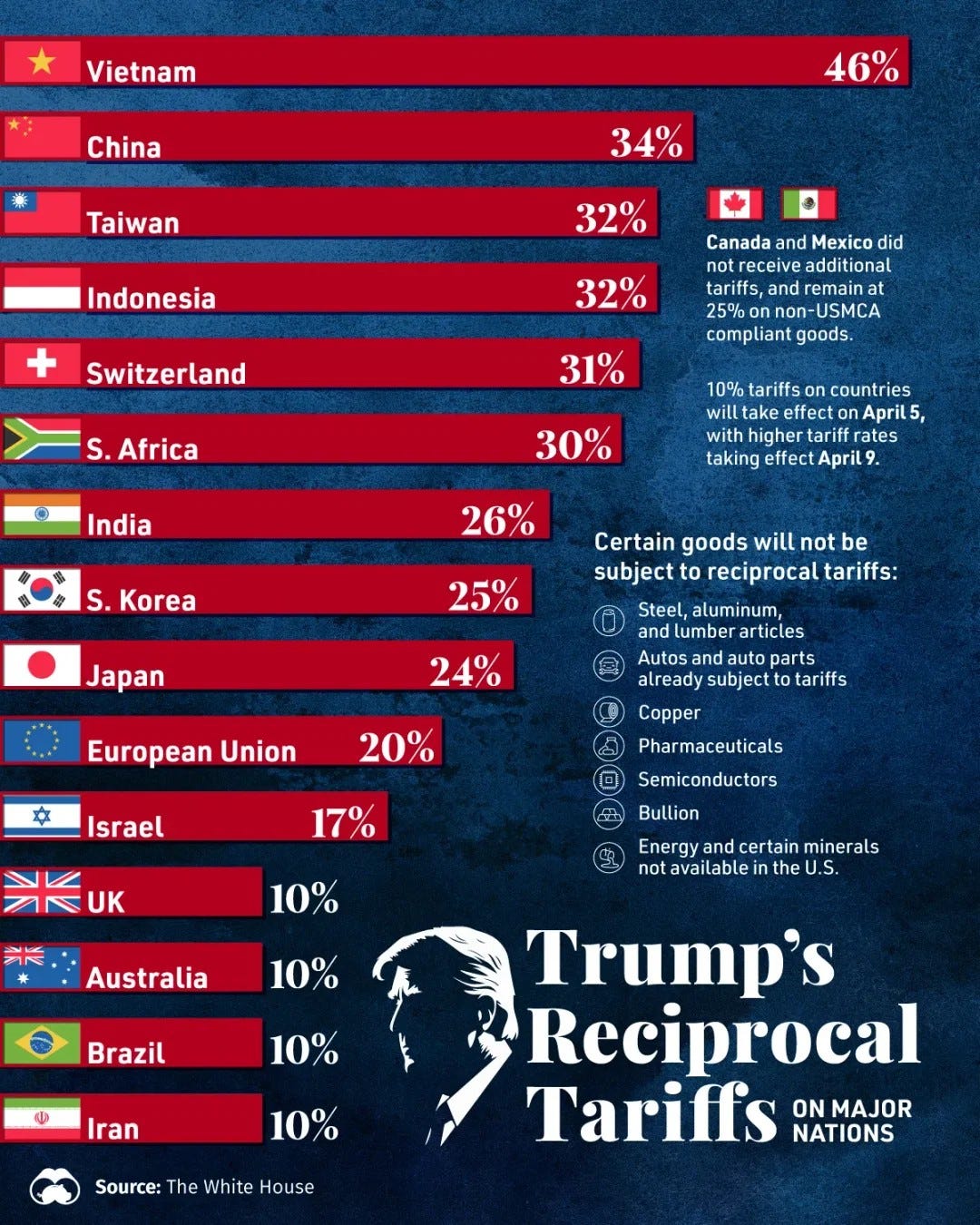
Courtesy of the Visual Capitalist
To develop strength militarily, economic strength is a prerequisite. Not only does the economy have to pay for the military, but it has to provide all the necessary technology and hardware to the militarily. Categorically, the needs of the military are the needs of the citizenry; food, water, medicine, transportation, communications, security, and so on.
The British System is the one of so-called “free trade,” which is a myth; there is in reality no such thing as free trade, despite the fact that we’ve been propagandized for generations into believing that not only does such a thing exist, but that anything else is sacrilegious. I’ve come to believe otherwise. I wrote a two-part series some years ago titled, Free Trade: What Could Go Wrong?, but in hindsight most of the things I identified are not simply bad “side effects,” they are rather the desired outcomes!
Scale
Urbanization
Long, Brittle Supply Chains
Specialization, and
Externalized Costs
But back to the point; the hollowing out of our industry, especially in the flyover states, is absolutely due to “free” trade. I will just cite a couple of examples.
Medical Supplies
The percentage of medical supplies coming from China varies significantly by product type and country, with no single overall figure. For the United States, China is a major supplier of personal protective equipment (PPE), providing 54% of imported PPE products, 70% of mouth-nose protective equipment, and 71.9% of certain PPE categories like face masks. For pharmaceuticals, the U.S. directly imports about 9.2% of its pharmaceuticals, medical equipment, and supplies from China, but this likely understates reliance, as 80% of active pharmaceutical ingredients (APIs) and 97% of antibiotics used in the U.S. are estimated to come from China.
— Brave searchElectronics
The U.S. imports a significant majority of several key electronic devices from China, with 66% or more of the following products by value coming from China as of recent data: game consoles (86%), PC monitors (79%), smartphones (73%), lithium-ion batteries (70%), and laptops (66%).
— Brave search, andRare earth minerals
Between 70% and 80% of rare earth compounds and metals imported by the U.S. originate from China, with some reports indicating 96% of total rare earth supply sourced from China in 2025.
— Brave search
From both the economic and military perspectives, near-total reliance on China, a communist country, is simply unacceptable.
The last President to take on the British System was FDR, before that is was Lincoln (the most divisive President in history, hands down); and now Trump is taking it on. I pray he is successful.
Check out Promethean Action for frequent updates regarding reclamation of the American System.
https://www.prometheanaction.com/
And one video in particular:
All the best, and may God bless you and keep you,
John